Thursday, December 30, 2010

Degrees Are Just Paper / Happy New Year

I found this reprinted article by Elizabeth Ellis of the Minnesota Spokesman-Recorder simple and pointed enough to pass along here. I don't know who Ms. Ellis or or what the Spokesman-Recorder is, but this piece, titled "College degree is no employment guarantee" is more true in theory than almost any hack mainstream editorial I've read in the last year. While not about law school, this line jumped out at me:
Competition among recent law school graduates is so intense that one I know of is a groundskeeper.
Pre-law students, this woman is not a disgruntled law grad or student with a bitter axe to grind. She is merely an observer who notes that it's the out-of-whack ratio between graduates and jobs that caused his predicament and not his own personal failures.

I cannot say this enough times: a degree is just a piece of paper. It does not reflect any intrinsic value or relay any particular effort to the world. Like any other commodity - including money - its value is not constant, and it may be absurdly overvalued as the laws of supply and demand may dictate (although money is a bit different when it comes to that, but moving on...). Growing up, we (children of the 80s and 90s, maybe others) were all shown a chart eerily similar to this ungodly, misleading mess:
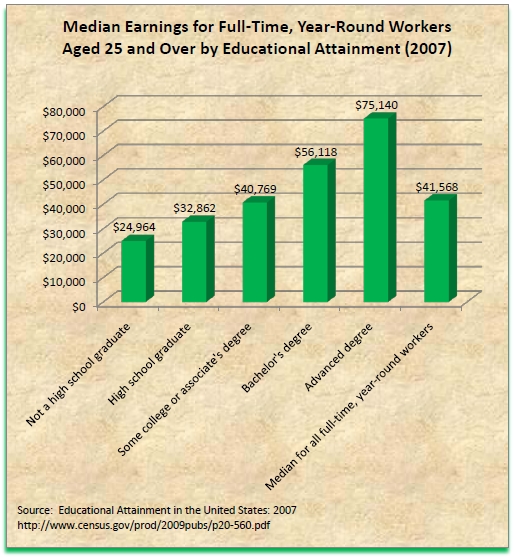
These charts are foul, far worse than Joe Camel advertising or cartoon pornography or anything else we tried to keep from the eyes of impressionable children. Their massive proliferation amongst enthusiastic guidance counselors trying to persuade kids to go to college reveals a society not only flooded with the materialism of thinking a salary determines one's prestige, success, and worth as a human being, but also reveals a society ignorant of the laws of economics and statistics.

Instead of teaching children the laws of supply and demand and that being in an in-demand field means more for one's salary than level of educational achievement, we gave them the most lazy directive possible: go to college and make more money. Instead of teaching them that the correlation between degrees and earnings does not mean that the degree causes the earnings, we told them having a degree would surely make them more money over their lifetime. Instead of realizing the investment lesson that past returns do not guarantee future results, we ignored making any kind of projections; surely, we told the leaders of tomorrow, a college business major would make more than a plumber or an electrician or a mechanic or a garbageman. Surely! We systematically set aside professions that simply weren't for mommy and daddy's high achievers, and as a result two whole generations went (and are going) to college to get the B.A., the B.S., the J.D., the M.B.A., the Ph.D, the M.A., the whatever.

And now there's such an overpowering supply of them compared to the demand that the laws of economics have caused a new reality to dawn: the degrees are not a one-way ticket to a better financial life, that the chart is and always has been utter bullshit, and that education is not the same thing as useful knowledge. The world needs smart, hard-working people, whether they have degrees or not. We need to realize that despite their marketing ploys, colleges are a business, students are consumers, and often times the colleges flood the marketplace with completely useless and grossly-overpriced products. If someone calls education an investment, apply investment principles; ask him if he would ever take a 30-year mortgage to spend $150k on property upgrades that had no guarantee of ever raising the market value of the property. No one in their right mind would do that.

But useless ornamentation are what college degrees have become in many cases, thanks to a decades-long propaganda effort. And because everyone saw the same chart and rushed to school, we have an oversupply of educated people, many of whom are destined to failure by sheer numbers. Many of the remainder are left depressed and anxiety-ridden by the intense competition. In both sets, their ability to have and sustain families is greatly hampered.

Prevailing wisdom is a powerful force, especially since the baby boomer generation is replete with morons who C-averaged their way through God-Knows-Where State and now make $90,000 and act as if it should be just as easy for any college graduate today to excel while continuing to propagate the myth that a degree equals a brighter future.

But a degree only raises your economic value if it makes you an in-demand economic commodity. There are always professions that need degrees: doctors, architects, engineers, researchers. If that is your dream, go for it. I even think law school still makes sense for the right student. I won't even tell you that money is an improper motivation. Sometimes, it can be, especially if the degree is cheap in comparison to the projected lifetime earnings/in-demand nature of the field (nursing, for example).

But I will tell you it's a small, small minority of those currently applying to be part of next year's massive flock that really need to be there, maybe only 1/4 or a 1/3. Most degrees do not really give you any prestige anymore in an age when PhDs and J.D.s are given out like candy. Nor will you really become a more well-rounded individual as a result. If you have the thirst for knowledge, you will become a bright individual whether it comes from some overpaid jackass snob who wears a scarf and a beret indoors or from a book you read on your own. As Will Hunting noted, a good library can give you the same education as paying full tuition. As someone who went to a USNWR top 15ish undergrad school, I'll tell you that there's nothing special about my education in the liberal arts I couldn't have learned - likely quicker - in a good public library.

At the end of your life, no one will give a shit what degree you had except maybe the college that gave it to you, and that's only if you're rich enough they can beg for some of your estate to build something new. Do not lose sight of what is really important in your life to chase that stupid sheet of paper. It is nothing more than a product, an investment, a commodity, and for the average student right now, I'm not sure many post-secondary educational programs are really worth the purchase price.

I don't care what choice you make, but if I can get just one 18, 22, whatever-year old to think of their degree as a product rather than as just "the next thing to do" in a series of pre-ordained life steps, this blog will be successful. You would never pay $100k for a used Kia Rio, would you? Why do it with a sheet of paper?

If you are 18, 22, whatever, and you feel like you have no direction, nothing else to do, no job, let me tell you this: you are surely creative enough to find something better to do than overpay for the "privilege" of sitting in an English 101 or Torts I class that may never make you more marketable or increase your chances of getting a job. Don't be lazy; that was your parents' and your guidance counselors' mistakes and we can't afford to perpetuate the silliness.

Originally I planned this to be a very short entry, but then I done gone a-rantin'. Sorry about that, you ADHD folk, although most of you have probably clicked elsewhere by now.

I'm out until after New Year's, probably well after the new year. I hope everyone has a happy and safe end to 2010. I've had a great first few months on the blog and I'm looking forward to 2011; I have a project that I've been working on that I'm really looking forward to. 'Til then, take care, and Happy New Year!

Propagandist of the Week: Bob Morse

This is from Bob Morse's latest defense of the USNWR rankings, titled "Law Schools Report Accurate Data to U.S. News":
Just how honest were law schools when they reported their data to U.S. News for our 2011 Best Law Schools rankings? Each year, we ask law schools to report the same statistical information to us that they report on the American Bar Association's (ABA) annual accreditation questionnaire. Despite some notable exceptions and data errors over the years, it turns out the schools are pretty reliable in their data reporting.
To support this absurd confusion of reliability with honesty (you can reliably lie, can't you?), he points to a correlative study done by Chapman's Tom Bell, which takes the data provided to the ABA and uses the USNWR's methodology to reach the same conclusions that USNWR did. Then Morse drops this absolute gem of propaganda bullshit:
The fact that Professor Bell was able to duplicate our methodology by using law school data he obtained directly from the ABA proves that the U.S. News rankings process is very transparent and can be duplicated using publicly available data. This exercise also establishes that U.S. News is calculating and weighting the ranking variables as stated in the posted methodology. Users of our law school rankings can be confident that the results are correct given the weights and rankings variables that U.S. News has chosen.

Finally, does Bell's study also prove that law schools are being accurate in how they report their statistical profile data to the ABA, the general public, and U.S. News? No [ed.: yet your opening speaks of "honest" schools because _______?], this only proves that law schools are being very careful to report the same data to U.S. News that they report to the ABA for accrediting purposes.

Has anyone, in the history of the USNWR rankings, doubted that USNWR was using data that wasn't identical to that given to the ABA, especially since the ABA information is public and USNWR, being excellent journalists, would surely cross-check their data? Has anyone ever suggested that law schools are not "being very careful to report the same data to U.S. News that they report to the ABA for accrediting purposes?"

As far as I know, they haven't. Instead, all Morse did here was publish a blog entry to say that some professor took the listed methodology applied it to the exact same data set, and came up with scientifically-similar results. What the hell is that supposed to show, again?

Ah, yes, that "the results are correct given the weights and rankings variables that U.S. News has chosen."

For most people, the word "correct" would imply that the substance of the rankings is correct, e.g., that Harvard is a better law school than Georgetown, rather than the process used to form the rankings was scientifically sound. Take a look at certain fragments of this piece in order:

  • ...schools are pretty reliable in their data reporting.
  • ...the U.S. News rankings process is very transparent...
  • ...U.S. News is calculating and weighting the ranking variables as stated...
  • ...the results are correct...

The way this was composed is deliberately designed to defend the whole system, including the substantive results. The fact that in the next paragraph he disclaims "but the data may not be good" doesn't change the fact that he spent the rest of the piece defending the results derived from that data.

The first issue is, and always has been, that their methodology is fatally flawed. The second issue is, and always has been, that the numbers presented to them are inaccurate.

The fact that Morse was able to take a complete non-story not even worthy of a blog entry and turn it into a rhetorically-sound defense of the rankings' value is admirable. I'm baffled that a professional writer and statistician can conflate the concepts of reliability, honesty, accuracy and precision all in one post. Of course, he did almost the exact same thing a year and a half ago.

The fact that Professor Bell was able to duplicate our methodology and outcomes using data collected from a different source proves that the U.S. News rankings process is very transparent and accurate.

Professor Bell concludes:

"For now, I'll just offer this happy observation: The close fit between USN&WR's scores and the model's scores suggests that law schools did not try game the rankings by telling USN&WR one thing and the ABA (the source of much of the data used in my model) another. Even a skeptic of law school rankings can find something to like in that."

Again, a complete non-story that does not justify the claim made ("the U.S. News rankings process is very . . . accurate") as read by lay people. It's not a "happy" observation and there is no hint that a "skeptic . . . can find something to like" since no ground of skepticism is weakened. The law schools' gaming of the rankings does not take place in presenting different data to the USNWR and the ABA. No one has ever thought that. What law school in its right mind would lie to a journalist when there's contradictory public information available? Do you think law school administrators are dopes?

On the bright side, at least this year's article had a one-line disclaimer that was somehow supposed to alleviate a plausible interpretation of the other four paragraphs. That still doesn't change the fact that it's shameless propaganda calculated to make the rankings seem "accurate," "honest," and "transparent," which seems odd given that just last week Bob was telling us not to take them so seriously.

Tuesday, December 28, 2010

Rep. Kawasaki Writes Back, Is A Buffoon

Dear Scott,

Because you didn't bother actually reading the email I sent you, I'm not going to bother taking the time to write you back personally. But I will gladly rip to shreds the lame reasons you provided for wanting to produce little Alaskan attorneys.
1. Alaska is unique in that we deal with international treaty and tribal sovereignty unprecedented in other states. We continue to send our best and brightest to learn law and some come back to practice here. Why should another states (sic) legal program dictate interpretation of our state laws? It can be done here and there is a market/talent pool of students who want to learn. We are the only state that imports all of its law students (ed. - you mean lawyers?) from the lower 48.
First of all, neither international treaties nor tribal sovereignty issues are "unprecedented" (do you even know what "unprecedented" means?). There is a festering mass of international law specialists who would love to work for cheap floating around D.C. and L.A., and tribal sovereignty issues are present in Oklahoma, Kansas, the Dakotas, and any state that deals with Indian Gaming. American Indian law is an interesting sub-field that, as far as I know, isn't desperate for specialist attention.

As the 2004 report notes, Alaska has very few law applicants each year, among whom only a select few are truly the "best and brightest." You are ignorant if you think 165+ LSAT people are going to go to UA-Fairbanks law school when Duke or Harvard offers them a substantial scholarship to claim their "students in all 50 states" thing. You have neither the talent pool nor the market to sustain a good law school.

And this idea "another states (sic) legal program dictate[s] interpretation of our state laws" is nothing short of ignorant. Even if that wouldn't continue to be the case, there is no magical trick of statutory interpretation that the UA would teach its students that would be one lick different than what [random lower 48 school] would teach.
2. Alaska has a huge need for physicians and specialties (sic) in rural medicine, alternative medicine and telemedicine. I think that we can become the best institution (ed. - Alaska is an institution? Who is "we?") for what we need the most. It is extremely difficult to recruit (I worked at a hospital) because of various factors. There is proof that students who graduate in an area tend to settle in an area (ed. - huh? Did you mean "in THAT area?") and I support growing our own workforce.
That's great. I said nothing about medicine, so I don't care.
3. There are roughly 16000 doctors and 16000 lawyers produced in a year. It has remained the same since 1980 and there is obviously a need. Roughly half of all physicians who are licensed in the US are from foreign schools right now! The need for quality health care (ed. - you mean the need for quality doctors, right?) will only increase as people live longer.
Scott, are you capable of organizing thoughts coherently? Or is this the "Alaska" mode of rhetoric and e-mail interpretation? For the record, there are 45,000 lawyers produced every year and the number has risen dramatically (unsustainably) since 1980. As I tried to explain to you, medicine and law live in different galaxies and cannot be equated. Stop doing it, you silly third-tier state representative.
4. Having a JD or an MD after your name doesn’t mean that will be the career you end with in the future (ed. - as opposed to ending with it in the past?). I have lots of associates who have JD’s but they run small businesses instead. We should encourage growth and self development and a higher level of education. We are all served better when people are no longer ignorant and Universities (sic) are to accomplish that mission.
My God, you have JD friends who aren't working as lawyers and you don't get it? How about you send them to business school if you want "growth and self development and a higher level of education?"

Or better yet, if you really want "growth and self development and a higher level of education," why not take the money you would spend on a law school and give your "best and brightest" a broad liberal arts education? At least then, they'd have a slightly more "enlightening" degree if they couldn't land a job, they wouldn't have the stigma of a J.D. (and yes, Scott, it's a stigma), and they would likely write and argue better than you.

I think I might move to Alaska. The cost of living is high, but the requirements to be a state representative seem awfully darned low. Anyone want to bankroll this carpetbagger?

Next Law School: ALAKSA!

I can't believe that since I've started this blog (less than two months ago), we've heard about three places that don't need them planning to build law schools: Delaware, Binghamton, and Kaplan U. in Washington D.C. Today we get to add a 4th: Alaska.
Rep. Scott Kawasaki today announced he will introduce legislation to create the UA School of Medicine and the UA School of Law at the two main area campuses in Fairbanks and Anchorage. Kawasaki said that the time to invest in education is now if we are to build the workforce that Alaska will need in the next 20 years. Kawasaki points to the continuing doctor shortages and the costs of healthcare and legal services.
...
"It is time Alaska begins to grow its own doctors and lawyers." Kawasaki said.
I'm sending Rep. Kawasaki an email about this, but unless the state is going to give away legal educations for free (or close to it) to in-state residents, which they likely cannot do, it's a colossally stupid idea.

First, this idea that you need more lawyers in Alaska because "the costs of . . . legal services" is high is absurd. A glut of unemployed JDs has done nothing to lower costs in any other state (see Florida, Illinois, California, New York, etc.), as the high cost of legal services comes from other price pressures rather than the high cost of labor.

Second, this idea that Alaska should be "grow[ing] its own" is laughable. If you live in a neighborhood where you have five neighbors and all of them grow twice as much corn as they need, you should rejoice that you don't have to grow any and get to buy theirs at a competitive price. Your response should not be "I'm going to pay and grow my own!"

This is the dumbest possible reason to start a law school. First of all, the imports are going to continue coming. Some of the more notable firms in Anchorage are multi-city firms with roots in Seattle or Portland, and they will continue to hire the best and brightest they can get. For example, Lane Powell has staffed its Anchorage office with grads from U. of Texas, U. of Chicago, and Duke. That's not going to change. Even if there were an Alaska law school, firms would still have an incentive to continue employing grads from higher-ranked schools; go look at Delaware: do you see Widener grads filling up Morris Nichols? Your most notable attorneys are going to continue to be "imports" for a long time to come.

Second, attorney salaries in Alaska are already dirt cheap (sorry I can't find a better source on this). Attorneys have this way of finding gold before legislators, and if there was a real demand for attorneys in Alaska, countless scores of unemployed Gonzaga, Willamette, Seattle, U. of Oregon, U. of Washington, U. of Idaho, Pacific, Pepperdine, UC-Davis, UC-Hastings, U. of San Francisco, U. of Montana, U. of North Dakota, U. of South Dakota, etc. etc. would have taken the next train to Juneau, just as they did when Las Vegas had some green pastures. They are not doing that.

Because the market demand is already more than met, legal services prices are not going to noticeably come down by purposefully flooding the market with your own homemade fourth-tier J.D.s. Because a hypothetical UA-Law degree would have no value outside Alaska, graduates would have scant few locations to work. Since their salaries would be low, and because of Alaska's location, it would have no prayer of ever moving up in the rankings or drawing in lucrative out-of-state tuition money that many schools find essential to being a viable law school. Perhaps Rep. Kawasaki is looking to North Dakota or Wyoming or Hawaii as models that work, but all of those schools have been around a long time and have substantial local alumni bases.

Given that there's no need for new attorneys, no chance for lowered legal costs, and no possibility that the state can draw in talented people from other states, there's no benefit to building an Alaskan public law school beside the hubris of "growing one's own." On the contrary, there's a substantial amount of risk in building a new public lower-tier school in a contracting field with an oversupply of labor, notably that you're going to piss off countless current Alaskan citizens by saturating their job market even further. Finally, because they can't draw out of state tuition money, lower-tier publics like those in Wyoming and North Dakota are subject to severe restrictions based on available public funding. Alaska, like every state, has tangible budget and deficit issues. This will likely prevent Alaska from ever escaping the fourth tier. Why would the state's "best and brightest" ever risk going there when they could go to Stanford or the U. of Washington (or Yale, for that matter) and come back and get a job with the Anchorage firms without issue? Many schools treat Alaskan residents like in-state residents (see the U. of Arizona for one example) because Alaska doesn't have a law school. Why would you throw away that perk?!?!?

This exact same issue was looked at in 2004, Rep. Kawasaki. The study concluded, among other things, that a law school was not worth it:
  • Taken together, all the data indicate that demand for lawyers in Alaska in the past five to 10 years has increased little.
  • Most of the ["new"] jobs will likely come from lawyers retiring or leaving the profession.
  • The available data are limited, but what we know indicates there wouldn’t be enough Alaskans (or students coming from other states) to meet the minimums needed to sustain a law school....
  • the information we gathered indicated that an ABA accredited law school could cost $40 to $50 million to establish and $6 million per year to operate. In a time of budget shortfalls and conflicting state needs, it is difficult to imagine that the legislature would appropriate the money....
Nothing has changed since then except now there are even more unemployed lawyers roaming around the United States, and therefore even less reason for Alaska to flood its own market.

This is an idea so dumb, I'm sure Sarah Palin probably supports it.

Sunday, December 26, 2010

Dumb Unethical New Attorneys is a Symptom, Not the Disease

As you've probably heard, there is an ongoing crisis not only with the wave of foreclosures, but how the foreclosures have been processed and handled in some areas, with rampant reports of fraud, incomplete documents, etc. You'll never guess what trait various investigative parties have noted about the attorneys who handled foreclosures in Florida:
Today, more than 260 attorneys work at four of Florida's largest foreclosure firms, and 48 percent of them have been practicing law for less than three years, according to Florida Bar records obtained by The Palm Beach Post.
...
With this fall's allegations of forged foreclosure documents, fraudulent notarizations and questionable affidavits submitted in tens of thousands of foreclosure cases, those nascent lawyers are now under a cloud of suspicion.

Some may face Florida Bar investigations that could end their careers, while homeowner advocates wonder whether the foreclosure crisis would have reached its state of disorder if it weren't for legions of novice lawyers doing the legwork.

Maybe I'm a bit naive, but something tells me that if you don't know using a forged affidavit or notarization is a bad thing on day one, you're probably not cut out to be an attorney. That said, it seems obvious that the Post was looking for a headline-grabbing scapegoat here and found one in youth rather than the system itself.

This becomes readily apparent if you read the whole article, which few did when newspapers were real and even fewer do online. Some select quotes:

  • Lack of experience could have led young lawyers to follow their employer's lead, unaware they may be committing an offense....
  • Florida Bar President Mayanne Downs said the Tallahassee-based group has no power to open its own inquiries....
  • [A former young attorney involved in foreclosures] said Stern's practice was driven by paralegals, who prepared most of the paperwork. "If there was shady stuff being done, it was being done without our knowledge," he said....
  • Even so, Downs said Bar leaders are generally concerned with the education of Florida's young attorneys. With 11 law schools in the state, she said there is a question about whether there are too many programs producing lower-caliber lawyers....
  • Downs suspects most cases the Bar investigates will result in blame being placed on a number of factors, including overwhelmed lenders, overworked firms and lack of oversight.

I wonder if Mayanne Downs has learned not to talk to reporters. In so many words, she told the entire world that her organization has no power to independently investigate dishonest firms, that the investigations they currently have will likely be blamed on factors other than unethical attorneys, and that the state's legal education may be in such disrepair that unqualified attorneys are being admitted to the bar her association is supposed to oversee.

That's the real problem here, isn't it? Sure, desperate, dumb young attorneys are a part of the mess, but that's not the headline here. The fact that there is a large mass of young attorneys desperate to do any kind of attorney work is a product of there being too many law graduates. Foreclosure mills and other legally-dubious enterprises can exist in such an atmosphere because the young attorneys - no matter how ethical they may be themselves - have little incentive to ask questions or look into what they're signing. One who takes the time to fulfill ethical obligations in any sort of idealistic sense is back to the unemployment line rather quickly. In a sense, it's the basic model of pre-unionized factories and 3rd-world sweatshops.

You could throw the book at the inexperienced attorneys who signed these fraudulent things, but in the end that's really only addressing a symptom. As long as there's a dirt cheap supply of competitive labor, you're playing right into the hands of shysters and exploiters because you've set up a system where an imbalance of power means the firm owners have a sort-of ethical monopoly. If the firm wants to discard legal ethics in the name of profit and take the risk, what prompts the young associate to say "no," if there's little other chance of a job and a 100k in student debt to pay off? If they say "no," eventually someone will say yes. If they report it to the authorities, there may be an investigation that results in the firm losing business, leaving the associate out of work.

Ultimately, bar associations are supposed to be the guardians against this type of situation by controlling the access of who gets to be an attorney in the first place. The fact that this situation happened isn't primarily the fault of young attorneys or even poor education, it's the fault of a system of bar associations (state and national) that has proven to be utterly ineffective at regulating the attorney profession, which has led to a drastic oversupply of attorneys and all associated problems. This is merely one of them; it is not the first apparent problem and it will not be the last.

Friday, December 24, 2010

News Roundup: Virtech Paralegal, Suing McDonalds, Debt Collections, and Merry Christmas!

Our first item up today is Virtech Paralegal, a company based out of Dallas that seeks to reduce economies-of-scale advantages held by bigger law firms by making it easier for solo practitioners and small firms to access paralegal services and organizational software. I saw this today about the company:
Last month, Virtech landed its first private financing – $500,000 from a local angel investor group – for marketing and to hire up to 40 people, said Brandon Lloyd, co-founder and chief operating officer of Virtech. Almost all of Virtech's nearly 20 clients are sole practitioners, he said.
...
Beyond its recent angel financing, Virtech plans to raise $2.5 million in a private stock offering to expand to new markets, enhance its software and hire more staff, officials said.
...
First Virtech plans to expand its paralegal service to Austin, Houston, San Antonio, and to other states, starting with California next year, Brown said.
Now, I don't think this company's model is going to revolutionize the legal industry or bring BigLaw to its knees or anything like that, but that's a lot of financing and a lot of planned growth for a young company. Reading between the lines, I'm guessing that their numbers are very good for them to nab to 500k and then turn around and discuss a stock offering for five times as much, with expansion to other markets within two years. Either these people are expansion/credit-crazy to a fault and their business will come crashing down faster than a housing bubble eating Krispy Kremes, or their model is showing some very good returns thus far and proving itself better than whatever else is out there. My gut says the latter and that this is a situation to watch in lowering costs for private practitioners.
--------------------------------------
Our next item up is McDonalds and yet another example of someone taking products liability/tort/trade practices/etc. theories obviously too far. I don't think this really needs comment:
The Center for Science in the Public Interest is representing the mother of a six-year-old girl in a class-action lawsuit on behalf of all California children under the age of eight who have been exposed to McDonald's "inherently deceptive and unfair" marketing in the last three years. The suit claims that McDonald's has "engaged in a highly sophisticated scheme to use the bait of toys to exploit children's developmental immaturity and subvert parental authority" and that arguments over Happy Meals have caused "needless and unwarranted dissension in their parent-child relationship."
--------------------------------------
Our third item is debt collectors. For the uninformed, the FTC has passed through a number of changes in debt collection law in the wake of the omnibus financial reform that took place last year, specifically to target deceptive practices. But as with all things where laws cannot cover the full gamut of clever means to the ultimate end, Creditbloggers reports that debt collectors are finding novel solutions. This one struck me in particular:
Another tactic: Pose as lawyers, who are exempted from the new rules. By setting themselves up as law firms, many debt resolution companies believe they can skirt the rules. But few consumers actually get to speak to a real lawyer, according to the letter, and if they do, the lawyer is usually not licensed to practice law in their state.
I would hope there's no attorneys dumb enough to set up these firms that exist solely to evade the law and perform what seems to me to be the unauthorized practice of the law, but I'm sure we'll be seeing more stories on this in the future. There's too much money involved in debt collection - especially as joblessness continues - for there to not be entertaining shenanigans in the murky debt collection sector.
--------------------------------------
The fourth item is that I want to wish all my readers who celebrate it a Merry Christmas!

Thursday, December 23, 2010

Guy Hacks Lawyers Wi-Fi and Has the Wrong Kind of Fun with It

From the ABA Journal:

Angry at a Minnesota attorney, a neighbor hacked his encrypted Wi-Fi account and e-mailed pornography labeled as family photos to his colleagues at a Minneapolis law firm, seeking to make trouble for him, authorities say.

Barry Vincent Ardolf, 45, also sent threatening e-mails purportedly from the attorney to the Minnesota governor and Vice President Joe Biden, reports IDG News Service, and set up a fake MySpace page in the lawyer's name.

He even posted child porn on the fake Myspace page (Myspace? What is this, 2006?).

People don't do this stuff to their doctor or their accountant. What did attorneys do to subject themselves to the wrath of all these nut-balls, and why did they allow it to happen?

Wednesday, December 22, 2010

Undignified Law Person of the Week: Brian Schroeder

Brian Schroeder is a Harvard Law graduate. But somewhere in its thorough* character and fitness evaluation, Harvard apparently missed some of Brian's finer qualities.
A Harvard Law School graduate has admitted setting a fire at a temporary New York City repository for Sept. 11 victims' remains. But he says he was too drunk to remember much about the blaze or explain his behavior.

Brian Schroeder apologized as he pleaded guilty Wednesday to arson and all the other charges against him in the Halloween 2009 fire. Over prosecutors' objections, a judge set the case on course for Schroeder to avoid any jail time when sentenced next year.

This dumbass caused $67,000 in damage and all he gets is a lousy 100 hours of community service. That's an entire year's salary for most people, and he can work it off in 2 weeks. What a joke! If a random 19 year old did this, he'd be in jail with the rest of the felons.

That's justice for you.

*Can you pay us the tuition? Do you LSAT/GPA help us out? Yes? You pass character and fitness!

Edit: while looking for the judges' email address, I found this is actually a month or two old. I'm leaving it anyway, as it's still egregious, ridiculous, and a microcosm of much of what's wrong with the justice system.

Tuesday, December 21, 2010

Cardozo = Yale

For this week's absurd law school rankings methodology, I give you Paul Caron at TaxProfBlog:

14

UC-Berkeley

369.0

39

Cardozo

340.5

15

Notre Dame

368.5


Yale

340.5

16

Georgetown

367.5

41

Wisconsin

338.5

17

Pepperdine

365.0

42

Samford

338.0


I'm not putting the whole list, but yes, he really did come up with a methodology that put Pepperdine in the top 20 and Yale equal to Cardozo, just ahead of Samford.

Virginia is the top overall school, and BYU is ranked higher than Harvard.

While I still think the USNWR rankings are a sham, coming up with alternative rankings that have similarly-absurd criteria isn't helping anything. To come up with these numbers, Caron took the response numbers from five subjective, non-quantitative Princeton Review surveys that were scored in the 60-99 range. He then averaged the two dealing with professors and added it to the remaining three numbers (about academic experience, admissions selectivity, and career preparation) to get the final numbers.

In other words, since it's based on a 3rd-party's flawed survey responses, it's absolutely, positively statistically sound. Garbage in, clean pure brilliance out, right? Isn't that how that quote works now that we're all living green? But I digress.

I should really come up with my own ranking system. It seems to be an easy way to make it into the news. Just rank someone like St. Thomas 50th or that Arizona State has a vastly superior law school to Cornell or Wash U. and I'm sure the hits skyrocket.

Well, I can play with numbers and claim [TTTT] > [T14], too. Stay tuned.

Monday, December 20, 2010

They've Outsourced Spam, Too

Sorry for the brief break. It's been a hectic few weeks. I finished my finals last Thursday and was on vacation over a rather busy weekend.

I was looking around for topics today and lo and behold I found the answer in my spam filter, for this putrid company not only exists (which is bad enough), but decided to spam one of the posts where I mentioned outsourcing. I've been meaning to make some posts about attorney advertising, but I think this outsourcing company's disgusting website is a good place to start, even though I know I'm preaching to the choir here.

You know it's a bad sign when a business has to rationalize its own existence. And there's plenty of it on SDD' website. Take this for example:
The ABA ethics opinion on legal outsourcing [ABA Comm. on Ethics and Professional Responsibility, Formal Op. 08-451 at 2 (2008)] described the trend towards outsourcing as: “a salutary one for our globalized economy.” The ABA Committee concluded that “there is nothing unethical” about the outsourcing of portions of legal services, so long as all services are provided with the “legal knowledge, skill, thoroughness and preparation reasonably necessary” for representation, and the lawyers involved satisfy their other professional obligations. The Committee also stated that outsourcing "affords lawyers the ability to reduce their costs and often the cost to the client to the extent that the individuals or entities providing outsourced services can do so at lower rates than the lawyers' own staff."
Right, and the ABA has shown itself able to understand ethics or economics...when?
Channel 4 Television Corporation hired SDD Global to assist in defense against a high-profile media libel case filed in the Superior Court of California, Los Angeles County. The case involved a plaintiff who sought US$800,000 dollars in damages, all allegedly due to the inclusion of her name in a comedy routine. SDD Global’s US-law-trained Indian attorneys handled nearly all of the litigation work for the defense, with supervision by U.S. attorneys. Granting Channel 4’s motion for summary judgment, the court threw out the lawsuit with a landmark decision that could benefit comedy writers, performers, television broadcasters, and film studios across the United States....
Channel 4 was delighted that it chose to fight and defeat the lawsuit, with the high-end yet low-cost offshore legal services provided by SDD Global. Without legal outsourcing to India, battling this lawsuit would not have made economic sense. With SDD Global doing most of the work, it was less expensive for Channel 4 to fight the suit, than to settle it.
This was one of the cases where some idiot sued Sascha Baron Cohen for making fun of them as his character Ali G. It's no where near the ballpark of "landmark" and was "thrown out" on two independent grounds, neither of which required going overseas or would have been too costly without outsourcing. "Battling this lawsuit would not have made economic sense" is a blatant lie.
SDD Global has also provided its services to solo practitioners in California. These attorneys were so overburdened with work that they had to turn down new clients.
So they then could absorb clients that could have gone to other struggling solo attorneys and kept them in business? That sounds wonderful, Random Indian Guy!

People who defend outsourcing often argue that American workers don't have the right skills to compete. Well, there is an excess supply of 15,000 government-backed, indebted lawyers pumped out in America every year who are trained specifically to write memoranda, draft basic documentation, and perform legal research. New graduates may not be ready to go to court or fly solo, but they certainly have the skills that this ridiculous leach of a company provides.

I continue to believe that anyone who defends outsourcing is mentally deficient in some key respect. The only people who benefit in outsourcing are the owners of the businesses (here, law firm partners). Cost savings to clients are marginal, and only rarely would they be passed to consumers. While a small number (business owners) may profit enormously, the decrease in jobs is an immense loss to a far greater number. The business owners who benefit disproportionately have a tendency to horde their wealth and not redistribute it by spending more on domestic products and services.

That, in five sentences, is the history of the last 40 years in America. It's sad that an organization like the ABA - who should be the ethical guards of the industry - can't see that it's become part of the problem instead of part of the solution. It's not merely a matter of economics when you bankrupt two generations and cripple the United States in the process; it's a moral one, too.

Wednesday, December 15, 2010

The Curse of Education (This Book > Your Commercial Outline Collection)

After reading BIDER's post on over-education in China, I went looking for a damning quote on education and I found a full book - something so much more enjoyable.

In writing briefs, it's generally considered poor form to cite to a case more than about 40 years old, no matter how dead on-point the language is, because whoever wrote it is probably dead and therefore the judge can't snipe at him if he or she disagrees.

Thankfully, in the real world, words are golden no matter who said them, and reading Aristotle will tell you more about humanity in 10 pages than [random politician/pundit/worthless academic] will tell you in five years.

With that in mind I give you The Curse of Education, a 1901 book by Englishman Harold Gorst. I imagine this to be obscure, and I can find nothing about Gorst except his father seemed to be a lawyer involved in English policy-making with regards to education. I know the book is real because the New York Times reported on it, but it seems Gorst and the book are otherwise neglected.

The main idea of the book is that rigid, mechanical educational processes kill genuine intellectual development and, thus, human progress. From the preface:
It is with education systems, with the universal method of cramming the mind with facts, and particularly with the manufacture of uniformity and mediocrity by subjecting every individual to a common process, regardless of his natural bent, that I have chiefly to find fault....[T]he foundations of all existing education systems are absolutely false in principle; and that teaching itself, as opposed to natural development and self-culture, is the greatest obstacle to human progress that social evolution has ever had to encounter.
The book is heavily steeped in a 1901 mindset. There are hints of social darwinism throughout and the book overwhelmingly focuses on men, devoting a chapter to good old-fashioned misogyny (he basically says that even though women lack the brain capacity of men, they use their minds more efficiently and to better practical use, e.g. developing superior habits of observation, because they've been "saved" from education - do with that what you will).

But there are still broad passages of the book that read like something any one of us concerned about the state of education in this country could write today, even though it's more concerned with elementary education. The book is public domain, so I'm going to copy from it liberally. Here's the opening:
The average educated man possesses no real individuality. He is simply a manufactured article bearing the stamp of the maker.
Like "Harvard" or "Yale" or "Thomas Jefferson School of Law," right?
Perhaps the worst evil from which the world suffers in an educational sense is the misplaced individual. Nothing is more tragic, and yet nothing is more common, than to see men occupying positions for which they are unfitted by nature and therefore by inclination; whilst it is obvious that, had the circumstances of their early training been different, they might have followed with success and pleasure a natural bent of mind tending in a wholly opposite direction. . . .

One has only to exert ordinary powers of observation to perceive that the world is not at all well ordered in this respect. . . . [O]ne of the most potent causes of this unhappy state of affairs is the exquisite infallibility with which a blind system is constantly forcing square pegs into round holes. . . .

[N]othing is more common in the States than to find individuals brought up to exercise functions for which they are wholly unfitted by natural capacity and inclination. . . .

The only thing considered necessary to equip a child for the battle of life is to get him an education, and nobody bothers his head about the principles or the effects of the process. The parent leaves everything to the school, regardless of the fact that schools do not pretend to concern themselves about the natural tendencies of their pupils. He is satisfied if his son is receiving the same education as his neighbour's, and is quite contented to leave the question of his future career to be an after-consideration.. . . .

[And] it scarcely requires pointing out that the enormous sums of money spent by Governments, by municipalities, and by private persons upon education, in order to produce this lamentable state of affairs, is so much waste and extravagance. Not only does it bring in no practical return, but it works out in a precisely opposite direction. Schools and colleges that only serve to produce anomalous and unnatural social conditions, that stifle genius and talent, and that cause widespread misery among the unsuitably educated, must be reckoned as a national loss. . . .
Notice any parallels between then and now? Enormous sums of money wasted? False ideas about education being a key independent of what the person is suited for? Educated people in the wrong field for them winding up miserable? I'm only two chapters in.

Skipping ahead a bit, we have this gem about the failure of the British elementary schools, which at the time (if I understand things correctly) was seen as a badge to a good career:
[T]he truth is, as we all know, that the product of the public elementary school is utterly useless, and generally wanting in intelligence. But these facts are only discovered by the victims themselves after years of bitter experience. Totally unfitted for any station in life, many of them leave school full of self-confidence in the belief that their superior education will secure them a good opening. Despising all manual labour, they seek situations as clerks, shop-assistants, and such-like. The result is, of course, an over-supply of candidates for employment of this kind.
An over-supply of white collar candidates who are "too good" for manual labor? Was this really written 109 years ago?
Schoolmasters are like mothers. They imagine that because a boy happens to have survived their system of teaching the latter must necessarily be the one perfect method—just as the fond mother, whose infant has been enabled by means of a phenomenal digestion to outlive a particular food, believes that it is the only food upon which babies can possibly be brought up.
The next time you heard a college dean bragging about the top students or the school while 70% of the graduates fail in real terms, remember this analogy. And when you read a story about college grads making minimum wage, recall that people across the ocean had the same reality check three generations ago.

After he has left school the same process is carried on at the university. Here he is crammed again with the same facts, the same rules, and the same ideas, borrowed from the same people, that are being dinned into scores of other young men who are working for their degree. Having gone conscientiously through this routine, he takes his degree with the rest.

This aim being accomplished, his educational career is over. He has graduated; that is to say, he has obtained a certificate to the effect that he has acquired a certain regulation stock of knowledge.

What happens next?

The unhappy graduate suddenly makes the discovery that his university qualification is not the ready passport to employment that he had fondly{64} imagined it to be. Unless he has a reasonable chance of a curacy and chooses to enter the Church, or can scrape together a few pupils to coach, or has the means to go on reading for the Bar or cramming for the public examinations, his prospects of immediate starvation are excessively favourable.

It was remarked some years ago by a writer who had spent a great deal of time in investigating life at common lodging-houses in the poorer districts of the Metropolis, that a startling number of university men seemed to drift into them. Yet these are the men who are supposed to have qualified themselves most highly for the holding of good positions. In some way, therefore, it is clear that this academic training has disadvantages which serve to handicap its victims severely in practical life. It cannot be mere accident that those who, according to all educational tradition, are classed as the most fit for responsible employment necessitating good mental ability, actually labour under obvious disabilities in this connection.

No, Virginia, it's not a new phenomenon.
Nature never intended all men to be cast in the same mould, and it is only the perversity of man himself that has brought the human race down to such a level. The stupidity of giving every scholar the same mental outfit is so self-evident as scarcely to need further comment. Even following the modern plan of stuffing minds instead of developing them, one would have thought that common sense would dictate the necessity of manufacturing as much variety as possible.
...
Competition amongst the 'well-educated' is not the result of over-population or of a too liberal supply of competent men. It is caused by uniformity of attainment; and until this is generally realized, one of the most pressing social problems cannot hope to find a solution.
Doesn't this damn the entire concept of giving out uniform degrees that are supposed to represent some kind of long-term accomplishment?

I've only combed out pertinent passages from the first half of the book, so feel free to explore the second half if curiosity so takes you there.

The grand message I got from this exercise is that even though Gorst's book is about education in the abstract, and mostly about elementary education in practical application (he's more concerned with mental development than the education of adult minds), there's quite a bit in there that speaks directly to the educational crisis in America.

Many of our problems, it seems, are universal. The trend towards uniformity, over-education, parental/counselor negligence, false faith in the education system: all of these show there is something innate about a recognized educational system that is wrong.

If Gorst noticed these flaws 109 years ago, surely any good, ethically-minded scholar or administrator in higher education would have noticed them by now, right? And maybe would have sought to correct the flaws, or prevent them from developing?

It's pretty clear to me that we have a system in the U.S. that promotes getting mechanized, uniform education at the cost of individuality, and that people often make dumb choices based on an irrational faith in the education system turning their little cogs into beautiful, money-making machines.

To win the battle over education in this country - or any other, it appears - we have to kill that faith and that mindset that seems, tragically, universal, or at the very least fully ground in by capitalist educators' perverse advertising.

Tuesday, December 14, 2010

Two to Scorn for the Price of One

First up in the "individuals deserving of my scorn" today is Ann Levine. If you recall, I've previously called Ann out for making up bogus and contradictory reasons to attend law school and for not reading or understanding what she cites to in order to support her commentary. So imagine my surprise when I ran across this article today where she does almost the exact same thing.

It's a well-intentioned piece about teaching students how to write a good personal statement. But what jumped out at me was this paragraph:
Q: I should start with something really dramatic.

A: Please don't. Lawyers don't write that way. You should worry less about shocking the reader and more about quickly piquing the reader's interest. Berkeley Law just posted a great example of what admissions committee members really think when you start your personal statement with a melodramatic tale. This is a must-read no matter where you are applying. Rather than trying to seek an emotional reaction, begin your personal statement with something honest and insightful.

If you actually read the article she links to, it says this:

It is very clear that many applicants have been coached by someone that this is how to write a compelling personal statement...This format is transparently manipulative, formulaic, and coached. Except for the occasional novelist we admit, none of our students or graduates is going to write in this style again; none, thank goodness, is going to begin a brief with, “He stood frozen in fear as the gunman appeared out of the darkness.” So, this artifice is irrelevant to law and counter-productive: Once it ceases to surprise – and it did so more than 10 years ago – it just becomes a cliché which really ought to be held against the writer. Not only using clichés, but also having been coached ought to, in an ideal world, discount an application. . . . [I]t is transparent when essay formulas have been coached, and we (should) strongly advise applicants to write in their own voice and style and without trying to dramatize what they have to say in order to attract our attention." (emphasis removed from original and added back where I see fit).

I have multiple problems with these excerpts. First, it would greatly help everyone if we were all honest and just admitted up front that personal statements are like exhibition games. You do it, but it doesn't really matter, and in the end it's your LSAT and GPA that get you places. A great personal statement really isn't going to save your 151 LSAT score unless you put it in an envelope with three-years tuition in advance.

Second, one of my pet peeves in writing is when people don't use consistent terminology. It's critical in legal writing to keep precise terms and know exactly what you're talking about. Here, the original piece is criticizing "cliched," "formulaic," "transparently manipulative" writing. By the time it got to Ann Levine's desk, it was transformed into "dramatic" and "melodramatic" and she tells you to be "honest and insightful." The Berkeley article addresses style, trying to get people to write in their own voice. Ann's mangling of the terms made it a content-based directive; instead of not "dramatizing," students are advised to avoid "drama" altogether. Those aren't the same thing.

Third, I have a major problem with both articles confusing the quality of the writing with the form the writing appears in. The problem with the examples the Berkeley piece provides isn't that they're "novel"-like or that they're dramatic, but that they're just flat-out lousy writing. Not all dramatic writing is bad, even in a legal context. A brief on the right subject matter can be both very effective and dramatic. But they're examples of good writing first. Take this opening of the summary from Paul Smith's Lawrence v. Texas brief:

As the experience of Lawrence and Garner vividly illustrates, Section 21.06 puts the State of Texas inside its citizens' homes, policing the details of their most intimate and private physical behavior and dictating with whom they may share a profound part of adulthood.
Don't you think that's trying to get an "emotional reaction?" That's more dramatic than it has to be, but it's effective, unlike the crappy writing styles that most nearly-illiterate law school applicants believe to be "good." You obviously can't do that with, say, arcane ERISA interpretations or in traffic court, but knowing how to phrase dramatic happenings within good, non-melodramatic writing is a very helpful skill in many areas of law. And being dramatic is the bread and butter of many trial attorneys.

But the biggest problem is what I've bolded above. In looking at said paragraph, it's impossible not to get the message that they hate when it's transparent that students are "coached." There is no way around the fact that Ann Levine is a law school "coach." The end message should be that they want to hear students' own voices and not something that has had the life sucked out of it by someone telling them what to write and how to write it, kind of like what Ann Levine does.

It's blatantly against her niche profession and yet she links to it as if she's above being a "coach," or perhaps maybe she just thinks her readers are dumb, or perhaps maybe she didn't comprehend the point. I don't think either is a great advertisement for her services.

---------------------------------------------------------

Second on my scorn list is this 38-year old doofus from the Charleston School of Law who put up 1,550 hours of "public service" at the local solicitor general's office and is now taking praise for it.

Kaufman, who earned a bachelor's degree in history from the University of Wisconsin Oshkosh, worked as an on-air radio personality for 14 years before deciding to enroll in law school.

It was in that career where he got his first experience with public service work, he said. His station sponsored an on-air campaign that quickly brought in $50,000 for a young woman who needed a liver transplant. "It was the most rewarding thing I've ever done," he said.

If he had done 1,550 hour of "public service" by actually helping people who need liver transplants, I would be all for it, and I would join the chorus of praise. But 1,550 hours for free at the local courthouse? That's 3/4 a work year they could have paid any number of people who are unemployed. Why, exactly, am I supposed to be happy about this?

I stand by my view that doing extensive pro bono work demeans the profession as a whole. Legal work is a valuable service

Sunday, December 12, 2010

Bankruptcy: Financial AND Moral - All in One Post!

Every time student debt forgiveness or any variant of said idea comes up, critics emerge from the rotted woodwork like cockroaches and spout the same refrain: these kids should have to pay / you borrowed the money, you pay it / there's nothing securing these loans / etc. It comes about in various permutations, but the motif of refusing to let student borrowers file bankruptcy almost always comes back to either self-perceived personal slights ("I paid my student loan from 1986 off and lived like a pauper...") or systemic concerns ("No one would give an unsecured loan like that!")

Well, all of those idiots should read this article about elderly people filing for bankruptcy to escape crushing debts when their income isn't what they expected it to be.
[P]eople 65 and older are the fastest-growing segment of the population seeking bankruptcy protection. . . .

Of course, the big question most seniors have when it comes to bankruptcy is: Will they take all of my retirement savings and leave me penniless?

"No," Connolly said. "Social Security and retirement accounts (up to approximately $1.1 million) are exempt from creditors so seniors will continue to have that stream of income."

What's more, many states have "homestead exemption" laws, which protect home equity from creditors. In Massachusetts, for example, you're protected up to $500,000.
So let's say Gertie, Age 70, has $1,000,000 in her IRA. She owns a home outright that is worth $400k in market value. She was successful until recently retiring. She was extremely prudent and has no debt. As a retirement gift to herself, she decides to take her excellent credit and go to Europe for two weeks and spend 20k splurging on herself. She gets back and suffers a heart attack and winds up 230k in medical bills.

Gertie has the assets to pay this off entirely and fairly comfortably. Her simple net worth is over $1 million. She's not going to live for much more than 15 years after this, and barring a severe penalty on distribution (I don't know how IRA's work completely if you're that old), she'll still have 50k a year to live off of.

But Gertie - who has unsecured debts of 250k plus interest - decides she wants to "leave a little something for the kids" and so she files bankruptcy and screws the credit card companies and the medical facilities who enriched and saved her life, respectively, on entirely unsecured credit. The rest of us pay for it.

Now consider Gertie's granddaughter Gertrude. I think you all know where I'm going with this. Gertrude takes out 100k to get an undergraduate education. In four years, she graduates magna cum laude from the big state university with a degree in business. She scores a 165 on the LSAT and gets accepted to a top-30 private law school, say Notre Dame, which is her dream because she's a lifelong catholic and blah blah blah. She excels at Notre Dame, makes law review, gets a federal court internship, and graduates in the top 7 percent of her class. She takes out 50k a year and graduates with a total debt around 250k. All of this is quite normal, and she thinks it's a good bargain because with her credentials the top firms in Chicago and Indy will fight for her. And they do - she lands a BigLaw job. It's great until she has a horrible car accident; not an expensive recovery, but her once-beautiful face becomes mangled and scarred, and the partners find a way to weed her out after 2-3 years.

She has about 200k in debt and zero assets. But unlike her grandmother, she cannot file bankruptcy to protect her future, even though she doesn't have the blessing of an approaching natural life expectancy threshold.

To those who are opposed to student loans having bankruptcy protection, what's the difference between Gertie and Gertrude? Both acted reasonably and had circumstances outside their control affect their financial situation, and both wound up with unsecured debts over 200k. Why should the one who has the assets to pay creditors in full be eligible to file for bankruptcy protection but not the one who hasn't a dime? Why does our system let elderly people who won't be around in two decades wipe the slate clean and leave money to heirs while we saddle young people with non-dischargable debt?

Anyone who believes this system of debtor relief has any notion of justice - or even rationality - behind it is not thinking clearly. We're supposed to have consistent laws in this country. A millionaire being able to discharge catastrophic medical bills (often brought by a less-than-healthy lifestyle) while students are stuck with their form of unsecured debt is patently unjust. It would take the brand of circular logic available only to Congressmen and partisan apologists.

---------------------------------------------

In the moral bankruptcy category, today I give you Liberty University School of Law, which was recently spotlighted in their local rag.
Central to the law school’s mission is the belief that God created law, and law is properly understood through a Christian worldview, Staver said.

Law without a Christian standard, Staver asserts, can become a “cold instrument of force.” ...

Professor Rena Lindevaldsen, who has a background in commercial law and religious right advocacy, teaches “Foundations of Law,” a required course for first-year students. It emphasizes the importance of limited government and the Biblical roots of the law. It also advocates an originalist approach to the Constitution, one that upholds the original intention of the founders, rather than viewing it as a dynamic document that can evolve over time.

“When you look back at any area of law, whether its torts or contracts or pick a topic, you can see that the Bible actually has principles that apply to this. It’s nothing new that we had to invent,” said Lindevaldsen, who has taught at Liberty since 2005 and earned her law degree from Brooklyn Law School.

There's so much more in the article that pretty much damns this place as a serious law school. And in the spirit of Christian fellowship, this school costs over $46,000 per year to attend. It was recently accredited (last 10 years), and your odds of finding a remunerative job are slim. Washington and Lee (ranked in the top 40) is an hour away. University of Virginia (T14) is an hour and fifteen minutes away. University of Richmond (top 100) is 2 hours away. And then there's the megalaw D.C. metro area.

I at least have to credit them for being seemingly honest on their employment statistics. Check this out:

That's brutal. I understand the desire for an organized church to have Christian lawyer-soldiers, but surely there's a better way of going about it than charging kids 50k a year to attend a place where only 47% have a real job 12 months later (and that's what they're reporting...). Ever heard of a scholarship fund? Personally, if I were a legal employer, any resume I got from this place would go straight in the trashcan, as I'm skeptical a brand new, Christ-first school can really teach the skills necessary to excel in the law, especially when the school is little more than a transparent vehicle for right-wing thought. I'm sure they know this, and with that in mind, it seems like a shameless cash cow to feed the University.

If you really wanted good Christian lawyers, wouldn't you be helping young Christians afford places like William and Mary or Virginia, where they can really do damage with a legal career? Maybe sponsor church activities for students already at those schools?

But it's not the first time evangelical Christianity has jumped on the profit wagon, and I'm sure it won't be the last.

Saturday, December 11, 2010

Sordid in the Steel City? Gender-Based Suits in Pittsburgh

Non-equity partner JoEllen Lyons Dillon has filed a gender equity suit against her current firm, Reed Smith, LLP. Reed Smith is the second-largest firm in Pittsburgh and has twenty-two offices across the globe. Interestingly enough, their motto is "The Business of Relationships." I think they might have taken it too literally. From the first article linked:
Attorney Samuel J. Cordes, who represents Ms. Dillon, said he found "that there is a pattern here of a male locker room, and it includes sexual favors," adding that his client didn't participate in that part of the "games guys play."...

She brought in millions of dollars of business annually, and sought a promotion from non-equity partner -- with no share in the profits -- to equity partner. She was not promoted, and after she took a few months off to have twins, her pay was "decreased almost by half" in 2009, according to the lawsuit. Then in January her pay was "reduced by another $100,000," it said, and her appeal of that decision was denied.
And then there's my favorite line in the story, which, typical for new-world journalism, comes at the very end as an afterthought:
Mr. Cordes said he would produce examples of sexual quid pro quos as the case continues.
Now, this isn't come crackpot pro se plaintiff doing this. This is a presently-working partner at BigLaw, who is both experienced and attractive enough to make the complaint pass any threshold skepticism.

Just a few blocks away, the Duquesne School of Law recently settled a discrimination, retaliation, and defamation claim with a former clinical administrator:
[She] claimed in her July lawsuit that Law School Dean Ken Gormley demoted her and cut her pay, among other things, in retaliation for her filing a sexual harassment complaint against him with the University's Affirmative Action Officer in 2006.
Now, I realize that settling a lawsuit is not an admission of liability and all that, but given that law school ethics should at least promote the appearance of propriety, I would have a hard time believing they settled a merit-less claim since, at least to me, it makes the dean look like a scum bucket, which I'm sure helps Duquesne's institutional integrity, especially with female students. And, as the article notes, there are two more claims for gender/racial discrimination still pending against the law school.

I find both of these interesting in light of the Allegheny Bar Associations explicit initiative - going back to 2008 - to specifically work against findings of massive gender inequality in Pittsburgh with their Institute of Gender Equality. Guess who was outgoing President of the Allegheny Bar in 2008, when this place was founded? Yep, Ken Gormley, who was also Vice-Chair of the Gender-Equality Task Force. This raises an eyebrow, doesn't it?

And curiously, even though Reed Smith is the second-largest place in town, they have no representation on the current Board of Governors (the 3rd-largest firm, Buchanan, Ingersoll, & Rooney, has at least two people on it).

I find these all interesting developments. Was Reed Smith key in the Allegheny Bar's findings that there were severe problems with gender inequality? Was the Institute of Gender Equality a mere meaningless action to look like it was solving the problem? Isn't Ken Gormley something of a gargantuan hypocrite for being on a Gender-Equality Task Force while his own female employee filed a seemingly-meritorious claim against him?

I don't know how to bridge this all together, but I find the seemingly-independent developments quite interesting and revealing of the tangled mess between firms, law schools, and bar associations that sometimes can prevent systemic change. Let's wait and see what happens with Ms. Dillon's lawsuit, especially if she has ammo and she starts using it over offers to settle.

Friday, December 10, 2010

On the USNWR Rankings

Kimber at Shilling Me Softly is reporting that the USNWR will adjust the information presented about its law school rankings to give a better portrait of the information colleges submit to them (i.e. by providing more information to put employment numbers in context, not any change to the methodology) based on articulated criticism from Law School Transparency.

Even though I don't like the concept of the rankings generally, I realize they do have an effect. I obviously think this is good news; isn't anything that presents a more honest picture of the legal profession?

But I wanted to talk more about USNRW in general. I found this article here, about a recent study of which USNWR was a partner that looked at the nature of college rankings (the article is part 2 of a 3-part series:
3. Do the U.S. News rankings "put pressure on institutions to invest in strategies and practices primarily for the purpose of maintaining or strengthening position in the rankings," either consistently or occasionally? An overwhelming majority (95.1 percent) of NACAC's members at both colleges and high schools believe that "Yes, colleges either occasionally or consistently invest in strategies and policies to improve in the rankings."
...
4. Does your school or institution make programmatic changes because of rankings? The report concluded that 54.1 percent of NACAC's members representing colleges reported that their particular institutions do not make any programmatic changes based on the ranking. However, it said that 7.6 percent say that their school consistently makes changes and 38.4 percent say that their schools make changes occasionally because of the rankings.
Although this is for the undergraduate sector, I strongly suspect that it applies equally (or greater) to law schools, and I find the timing of these revelations significant.

Notice anything curious about questions 3 and 4 when put together? Question 3 asked if schools in the generic sense put in policies to improve their USNWR rank. Question 4 asked members if their institution in particular did it (although I'm not sure what they mean by "programmatic" change and that seems like a question flaw; under a liberal definition of the word, it would mean anything, but people might interpret it narrowly).

In any event, I find the disparity between 3 and 4 interesting. 95% of respondents believe schools make changes, but only 46% of those reporting say their own school does it. Assuming no one thought they were the only school in the country that did it, that's a hypocrisy/sanctimonious rate of around 49%, i.e., those who thought other schools put in programs with the ratings in mind, but their school did not.

That's really high and USNWR isn't dumb. Although normally I'm cynical about such things, there's a part of me that honestly believes USNWR is getting the results back from this survey (and maybe others) and is realizing how widespread and destructive to academia their ratings have become. In the past few decades, USNWR has gone from being a news magazine to being a journalistic outpost whose sole practical purpose to most people anymore is to put out these silly rankings. And when someone's bread and butter may be tainted - and the above discrepancies show the college administrators have no qualms lying about their actions or their motives - it's usually wise to do something about it and find ways to correct the problem.

In the past few years, they've gone entirely online and faced major criticism from college presidents for their rankings. Given the results of both those developments, it wouldn't surprise me in the least if they were actually trying to take care of their rankings and nip accurate criticism - such as LST's that the information presented was not giving a complete picture - in the bud to maintain relevant.

Thursday, December 9, 2010

How To Get A Law School Accredited, Part I

Last month, The Legal Dollar did a great post pointing out the apparent conflict of interest in the ABA's Standards Review and the law schools it regulates, as 11 out of 14 members of the committee are professors or deans.

With that in mind, I'd like to direct your attention to Binghamton University. Binghamton is looking for a new President. And although it sits in a state flush with law schools, Binghamton has officially stated its desire to open a law school as its next "logical step:"
With only two public law schools in New York State, at the University at Buffalo and CUNY-Queens, estimates show a law school at Binghamton would be in high demand, both by Binghamton University students and others.
...
In addition, standard economic projections indicate new expenditures would reach $10 million annually within five years, with an estimated annual impact of $26.4 million on the region and $33.7 on the state.
Why is this important now? Well, with BU's Presidency open, you'll just never guess who's on their shortlist:
He might not have taken the traditional path to a presidency, but that doesn't mean attorney Jonathan Alger shouldn't be Binghamton University's next leader, he told an audience Wednesday during a campus forum.
...
Perhaps the most direct question from a faculty member: "When would you start building a law school?"

Alger, who sits on the American Bar Association's Accreditation Committee, which oversees the accreditation of the nation's law schools, didn't give a date but said he could certainly help facilitate the conversation. The conversation, he said, wouldn't be easy.
Like heck it won't.

Alger currently serves as Senior Vice President and General Counsel at Rutgers, where he's been since 2004. Rutgers is not only the place involving the video taping suicide scandal from earlier this fall, but also is a Big East football school whose program has been caught in embezzlement scandals. I mention this because just last season Binghampton had a major scandal where six of its players were suddenly booted from the team (and its AD resigned) after the University's effort to spend its way to basketball glory went awry.

You would think they would be looking for someone to reshape their image after that debacle, and that a candidate who was compliance officer at a university during a financial scandal.

But, hey, Binghamton wants its law school, and we'll see if they elect this current ABA Accreditation Committee member the leader to do it. The fact that they're considering him in their top five speaks volumes to me.

Wednesday, December 8, 2010

Law School Professors Protest! . . . But it's just some union thing

The annual meeting of the American Association of Law Schools is facing protests. Is it from disgruntled students facing a labor market where only 66% of them have jobs requiring their education? Is it from people with 150k in debt and a 40k job? Is it from excommunicated BigLaw associates who just got spit out of the system?

No - it's from law professors themselves. Is it because of the fundamental injustices that screw over 15-20,000 students every year by leaving them unemployed and deeply in debt? Is it from their educational institutions charging exorbitant amounts of tuition?

No and no. It's because of a labor dispute at one hotel, and it's not the first time our legal educators have gotten political.
...In letters to the AALS, the group said that it opposes the selection of the hotel because of an ongoing dispute between its management and a union representing unskilled and lightly skilled hotel workers.

This year's controversy mirrors problems that the AALS has faced in the past over its site choice for the annual meeting, attended by hundreds of law professors from across the country. In 2008, the AALS was forced to choose an alternate site in San Diego after legal educators balked at the selection of the Manchester Grand Hyatt. AALS members said they would not attend the meeting at that location because the hotel owner had given money supporting California's Marriage Protection Act.
If you all want to get political, how about not messing around with these small potatoes and working on the problems that are leaving two generations of young lawyers depressed and indebted while dragging the prestige and quality of the profession down with them.

Another New Law School? There's No Slowing This Conveyor Belt!


It seems like every day we hear of yet another law school being quickly erected to solve the drastic undersupply of fine legal institutions to learn at. This time it's the University of Delaware that's looking to get into the game:
The University of Delaware’s board of trustees has given administrators approval to pursue plans to build a public law school. The first class could be enrolled in 2015

The school would be Delaware’s first public law school. It would be on UD’s Newark campus. About 200 students would be enrolled in its first class.

Every time I read of a new law school opening - or even being the figment of some greedy administration's imagination - I fancy myself back in 2006 watching a house-flipping show ("you can make $20,000 just doing some paint touch-up and adding new chairs!") reading about yet another planned suburban shopping mall ("it'll have a Krispy Kreme and a Steve and Barry's!").

Originally, I was surprised to learn Delaware only has one law school (Widener), and only a private one at that; I realize it's a small state, but it's also the default state of choice for high-powered corporate litigation in America, and given their legislatures foresight in catering to the American corporation, one would think they'd have a public institution to help run their judiciary. But I suppose there's enough grads on the east coast to fill whatever need there is, and looking Widener up I see that that place is a two-campus behemoth spitting up 400-500 alumni each year, which is much bigger than I thought.

And the University of Delaware wants to pile on 200 more. Most law schools used to be fairly small; starting out as a 600-700-student factory would have seemed odd. But not in our day, where legal education has basically become a rush to set up the rigged carnival game for the next line of suckers walking down the boardwalk.

Delaware only has about 900k people in the entire state. Something tells me it doesn't need 600 new lawyers a year. Heck, I doubt it needs half of what Widener is spitting out.

Let's hope the University of Delaware administrators come to their senses. That Fighting Hen above won't be so happy when he realizes his degree won't be worth as much as his sweet, tasty flesh in a creditor's oven.

Tuesday, December 7, 2010

Iowa Judges Will Start Going Outdoors

Because Iowa has one of those screwy judicial retention measures that means judges who interpret the state constitution to let gay people marry will be hitting the bread line, the judiciary is now reaching out to Iowa's vast, slick P.R. industry:
At one point, Paul asked the crowd for a show of hands. How many drive Volvos and drink lattes?

Two or three. Maybe four.

"Trade the Volvo for a pickup truck with a gun rack."

The line drew a laugh, but Paul wasn't being totally facetious about charges of elitism. The message: Take off the robe and get out into the community. Talk to people. Show them who you are.
Being apolitical isn't the same as being a hermit, so I'm a bit lost as to why Iowa's judges need to be told to participate in the community. I'm a bit concerned that active judges going out of their way to meet-and-greet the scary proletarian class will wind up making the state judiciaries more overtly political than they already are.

For example, I think this is extremely misguided:
"To a limited extent, the response has to be political. Whether we like it or not, the office has been politicized by people who wanted to have our judges not retained. We need to be more engaged. But any campaign should be educational. Get to the civics behind it."
Okay - so on one hand you're telling judges not to be elitist, but on the other, you're telling them to become educational and tell people how things work? How do you think the average blue-collar conservative will take a mini-lecture on constitutional interpretation?

I'm all for encouraging judges and justices to be active members of the community, the same as any public servant. But active judges have no business going on political education campaigns that are nothing more than thinly-veiled political campaigns to retain themselves. The average person will see right through the difference, and as a result public confidence in the judiciary will be weakened because it will become just another political branch similar to the governor's office or the legislature.

To the Iowa judges, I'm sorry that you live and work in a state with a flawed constitution and an ignorant public that's made your offices outposts of political fervor. It could be worse; you could be a 1L at Drake or Creighton. But the answer is not for you to become more political in response if you believe in the principles underlying an independent judiciary. Sorry if it costs you your jobs, but I happen to think the prestige and integrity of the legal system is more important than you setting a precedent of active judges campaigning to keep their present gig on a retention vote. It's bad enough judges and would-be judges have to campaign in general elections.

Monday, December 6, 2010

Will Local Bar Associations Put Westlaw Out of Business?

Local bar association membership is dropping nationwide. Although we have a glut of lawyers in this country, tightening budgets mean that many experienced lawyers find no need justifying the membership cost and young lawyers don't have resources or the cause to join.

When this sort of thing happens to local organizations in America, do they just roll over and bend under systemic pressures? No, of course not! They develop gimmicks to draw renewed interest. And the Philadelphia Bar Association is doing just that:
...the bar association also will launch a legal database of Pennsylvania case law and statutes available free to members, with the hope of getting more dues-paying lawyers.
...
[Bar Association Chancellor Rudy] Garcia, 59, says the centerpiece of the membership drive will be the new legal database, offered as a free service to firms with 100 percent membership. The bar association projects that of the 25 largest firms in Philadelphia, each will be able to save at least $35,000 a year on top of new membership costs by using the service in place of other commercial legal databases.
Watch out, Westlaw.

All hints of sarcasm aside, I actually quite like this. Justice is an important public commodity in any democracy, and it bothers me that in our common law system the case law, especially for lower-level courts, is ultimately the province of two monolithic media companies, one Canadian and the other European. Legal opinions are in the public domain and there's no reason our courts and/or local bar associations could not keep databases of their own opinions.

And to get really crazy, it would be nice if there was maybe a national organization that represented attorneys that could run something similar. One of the biggest bars to entry (and high prices) in the legal field in research costs. For a young attorney starting out, it either takes prohibitive time (going to a law library) or cost (subscribing to a commercial service) to ensure that he or she is relying on good law. Given modern database technology, it's absurd that a simple search through the application of a particular state statute could cost hundreds of dollars.

If local bar associations (or even a national one) take back our case law from the foreign capitalist oligarchs, the cost to the associations shouldn't even be that high. I would think it would be a productive way to earn CLE credit to volunteer on such a system, and if volunteers can fill a site like wikipedia (or even a site like gutenberg.org), I think a comprehensive system of case law would be feasible.

I don't mean to suggest that the Philadelphia Bar Association is the first to do this. They aren't. I just think it's a welcome trend for which a national collective project would greatly aid all parties save the Canadians and the British.

Sunday, December 5, 2010

A Minor Victory Of Common Sense

The ABA has put off its decision on the possible accreditation of foreign law schools:
The Council of the ABA’s Section of Legal Education and Admissions to the Bar on Saturday put off a decision on whether to accredit foreign law schools, saying the matter needs more study.

The unanimous vote by the council, meeting at the Bayfront Hilton in San Diego, came after a 20-minute discussion, and called for a complete vetting of the issue with potential stakeholders. No time limit was set for completion of the study.

If only they could halt the accreditation of domestic law schools to do "more study" on the potential ramifications.